
Sustainable Cooling Solutions for Warmer Cities
Urban residents across the world are experiencing hotter summers, longer heatwaves, and increasingly uncomfortable nights, as cities trap and amplify heat in ways that surrounding rural areas do not. In this context, sustainable cooling is emerging as one of the defining environmental and public health challenges of the century, and also as a field rich with innovation, collaboration, and hope. For plants and flower power loving individuals here who follow developments in sustainable living, circular economy, and climate-resilient design, the transformation of urban cooling offers a powerful example of how technology, policy, and everyday choices can work together to protect both people and planet.
The Urban Heat Challenge and Why Cooling Matters
Cities tend to be several degrees warmer than nearby countryside because of the urban heat island effect, driven by dark surfaces that absorb sunlight, dense building forms that trap heat, limited vegetation, and waste heat from vehicles, industry, and air conditioning. Research compiled by organizations such as UN-Habitat and the World Meteorological Organization shows that heatwaves are becoming more frequent and severe in many regions, from North America and Europe to South and East Asia. These trends are particularly dangerous in dense urban environments where older adults, young children, outdoor workers, and low-income communities often have the least access to safe cooling.
Cooling is not only about comfort; it is a life-saving service. The World Health Organization notes that heat-related mortality can rise sharply during extreme events, especially when night-time temperatures remain high and bodies cannot recover. At the same time, traditional air conditioning based on fossil-fuelled electricity and high-global-warming-potential refrigerants risks creating a vicious circle: more heat drives more cooling demand, which in turn can increase greenhouse gas emissions and further intensify climate change. Analyses by the International Energy Agency indicate that space cooling is already one of the fastest-growing uses of electricity worldwide, particularly in rapidly urbanizing regions.
This is where the concept of sustainable cooling becomes central. Instead of simply adding more conventional air conditioners, cities, businesses, and households are beginning to rethink how spaces are designed, powered, and managed to stay cool in ways that are energy-efficient, climate-friendly, and socially inclusive. For readers exploring broader themes of sustainability and sustainable living, sustainable cooling provides a concrete lens through which global climate goals translate into daily life.
Rethinking Cooling: From Product to System
A key shift in recent years has been moving from a narrow focus on the efficiency of individual air-conditioning units to a systems perspective that considers buildings, streets, vegetation, materials, and energy supply together. Organizations such as the UN Environment Programme and the Cool Coalition emphasize that the most sustainable cooling is often the cooling that is not needed in the first place, because buildings and cities are designed to stay comfortable with minimal mechanical intervention.
This systems approach typically follows a hierarchy. First, reduce the need for cooling through better urban planning, building orientation, shading, and insulation. Second, improve passive and nature-based cooling so that breezes, vegetation, and reflective surfaces do more of the work. Third, ensure that mechanical cooling, when needed, is as efficient, low-carbon, and refrigerant-safe as possible. Finally, integrate cooling into broader energy and climate strategies, including district systems and renewable power.
For Eco Natur, which explores how design, energy, and lifestyle intersect, this hierarchy aligns naturally with themes of sustainable design, renewable energy, and zero-waste thinking, where efficiency, prevention, and circularity come before resource-intensive solutions.
Nature-Based Cooling: Greenery, Water, and Biodiversity
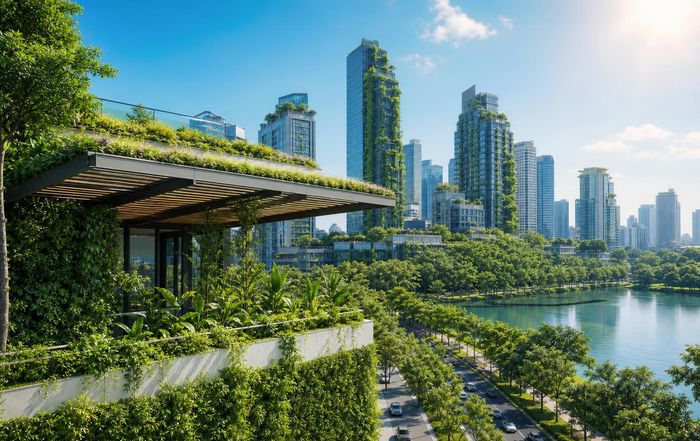
One of the most visible and inspiring developments in sustainable cooling is the resurgence of green and blue infrastructure in cities. Urban trees, parks, green roofs, and water features can significantly lower local temperatures by shading surfaces, reflecting sunlight, and promoting evapotranspiration. Studies compiled by the European Environment Agency show that well-planned urban greening can reduce local air temperatures by several degrees during heatwaves, while also improving air quality and mental well-being.
Cities such as Singapore, often cited by the World Economic Forum for its "city in a garden" vision, have integrated vertical gardens, park connectors, and water-sensitive urban design to moderate heat and manage stormwater. In Europe, cities like Paris and Milan have expanded tree planting programs and green roofs as part of their climate adaptation strategies, while in North America, initiatives in cities such as Toronto and Los Angeles focus on increasing canopy cover in underserved neighborhoods that historically lacked investment in shade and parks.
Nature-based cooling also strengthens urban biodiversity. Pollinator-friendly green roofs, restored wetlands on city fringes, and native tree planting can create habitats for birds, insects, and small mammals, contributing to broader ecological resilience. Readers interested in the links between cooling, wildlife, and biodiversity can find numerous examples where urban climate adaptation doubles as habitat restoration, providing both local and global benefits.
Water-sensitive design, including ponds, fountains, and restored riverfronts, can also help cool microclimates, although careful planning is needed to manage water use and prevent unintended consequences such as mosquito breeding. Guidance from organizations like ICLEI - Local Governments for Sustainability and C40 Cities provides case studies and technical resources for municipalities seeking to integrate nature-based cooling into broader climate action plans.
Cool Surfaces and Reflective Materials
Alongside vegetation, material choice is a powerful lever for cooler cities. Dark roofs and asphalt absorb large amounts of solar radiation, heating the air above and contributing to the urban heat island effect. "Cool roofs" and "cool pavements," which use reflective coatings or light-colored materials, can significantly reduce surface temperatures and, in turn, lower indoor cooling needs.
Research supported by the Lawrence Berkeley National Laboratory and referenced by the U.S. Department of Energy indicates that reflective roofs can reduce building cooling energy use in hot climates, while also extending roof lifespan. Some cities, including New York and Athens, have launched large-scale cool roof programs, coating millions of square meters with high-albedo materials. Similar initiatives are emerging in parts of India, where the India Cooling Action Plan highlights cool roofs as a cost-effective measure for low-income housing.
Permeable and reflective pavements can also cool streetscapes while improving stormwater management. However, urban planners must balance glare, durability, and pedestrian comfort, especially in regions with intense sun. For followers who explore sustainable business practices, these material innovations illustrate how construction companies, coating manufacturers, and local authorities can collaborate to deliver climate-responsive infrastructure while creating new green jobs and market opportunities.
Passive Building Design and Climate-Responsive Architecture
At the building scale, passive design principles-many of them rooted in traditional architecture-are being rediscovered and refined with modern tools. Orientation to capture prevailing breezes, deep overhangs, adjustable shading, cross-ventilation, thermal mass, and high-performance insulation can drastically reduce the need for mechanical cooling. The Passive House Institute and similar organizations promote rigorous building standards that prioritize airtightness, insulation, and controlled ventilation with heat recovery, which in warm climates can be adapted to manage both heat and humidity.
Architects in regions as diverse as the Mediterranean, the Middle East, and Southeast Asia are drawing on vernacular techniques such as courtyards, wind towers, and shaded arcades, while integrating modern glazing, materials, and engineering. Publications by RIBA in the United Kingdom and AIA in the United States highlight growing interest in climate-responsive design as part of net-zero carbon building strategies.
For urban residents, these design choices translate into quieter, more comfortable interiors that rely less on noisy compressors and more on natural light and airflow. This aligns strongly with the holistic approach to health and well-being emphasized in eco-natur's lifestyle coverage and health-focused content, where environmental quality, thermal comfort, and indoor air quality are seen as interconnected aspects of sustainable living.
Efficient, Climate-Friendly Cooling Technologies
Even with the best passive strategies, mechanical cooling will remain necessary in many climates, particularly during extreme heat events. The challenge is to deliver this cooling in ways that minimize energy use and climate impact. Recent years have seen significant progress in three main areas: equipment efficiency, refrigerant management, and integration with clean energy.
Efficiency standards and labeling programs, supported by agencies such as the International Energy Agency and the U.S. Environmental Protection Agency, have pushed manufacturers to produce air conditioners and heat pumps that deliver more cooling per unit of electricity. In some markets, variable-speed inverter technology has become a mainstream feature, allowing systems to adjust output more precisely and avoid the energy waste of frequent on-off cycling.
Refrigerants are another critical piece. Many older systems use hydrofluorocarbons (HFCs) with very high global warming potentials. The Kigali Amendment to the Montreal Protocol, which is being implemented by a growing number of countries, aims to phase down these substances and encourage a shift to lower-impact alternatives, such as certain hydrofluoroolefins (HFOs), natural refrigerants like propane (R-290) in small systems, or ammonia and CO₂ in industrial and district applications. The UN Environment Programme's OzonAction program and technical guidance from industry groups document both the opportunities and the safety considerations associated with these transitions.
Heat pumps, which can provide both heating and cooling using electricity, are increasingly recognized as a cornerstone technology for decarbonizing buildings, especially when paired with renewable power. Reports by the International Renewable Energy Agency and IEA highlight how heat pump deployment, combined with building envelope upgrades, can reduce overall energy demand while enabling cities to phase out fossil-fuel-based boilers. For eco-conscious businesses and households, this convergence of efficient equipment and clean electricity connects directly with broader discussions of renewable energy transitions and sustainable urban economies.
District Cooling and Shared Infrastructure
In dense urban areas, district cooling systems-centralized plants that chill water and distribute it through insulated pipes to multiple buildings-offer a way to deliver efficient, large-scale cooling with lower environmental impact. These systems can leverage economies of scale, use waste heat or cold from industrial processes, and integrate thermal storage to shift electricity demand away from peak hours.
Cities such as Dubai, Singapore, and Stockholm have expanded district cooling networks, often in partnership with utilities and private operators. According to analyses shared by the International District Energy Association, well-designed district systems can reduce energy consumption and emissions compared with standalone chillers, particularly when they use renewable electricity or low-carbon heat sources. However, successful implementation depends on careful planning, long-term investment, and supportive policy frameworks.
For Eco Natur's audience interested in sustainable business models, district cooling illustrates how infrastructure-as-a-service can align financial returns with environmental performance, especially when contracts reward efficiency and emissions reductions rather than simple energy throughput.
Cooling, Circularity, and Plastic-Free Futures
Sustainable cooling is not limited to air temperature; it also intersects with materials, waste, and consumer behavior. The global market for cooling-related products, from insulation and window films to fans and portable coolers, has traditionally relied heavily on plastics and difficult-to-recycle composites. As awareness of plastic pollution grows, innovators are exploring bio-based materials, modular designs, and take-back schemes that support a circular cooling economy.
Efforts to reduce single-use plastics, documented by organizations such as Ellen MacArthur Foundation and OECD, increasingly include cooling-adjacent products like disposable cool packs, polystyrene foam containers, and plastic-rich HVAC components. For those following Eco Natur's explorations of plastic-free lifestyles and recycling strategies, sustainable cooling opens new questions: how can materials be chosen to minimize environmental impact across the entire life cycle of cooling systems, from manufacturing and installation to maintenance and end-of-life recovery?
Extended producer responsibility schemes for appliances, promoted in regions such as the European Union, are beginning to address the safe recovery of refrigerants and the recycling of metals and plastics from end-of-life air conditioners and refrigerators. Guidance from Basel Convention bodies and national environmental agencies stresses the importance of proper handling to avoid both toxic releases and climate-damaging refrigerant leakage.
Food, Health, and Cooling Along the Supply Chain
Cooling is also essential for preserving food and medicine, especially in warmer climates. Cold chains that connect farms to markets and households are vital to reducing food loss, ensuring food safety, and supporting nutrition. The Food and Agriculture Organization and the Global Food Cold Chain Council have documented how inadequate refrigeration in parts of Africa, Asia, and Latin America leads to significant post-harvest losses, undermining livelihoods and increasing pressure on land and water resources.
At the same time, expanding cold chains using inefficient or poorly maintained equipment can drive up emissions. Sustainable solutions in this space include solar-powered cold rooms for smallholder farmers, efficient refrigerated transport, and climate-friendly refrigerants. These approaches align closely with the interests of fans who follow organic food systems, as resilient, low-impact cold chains can support local, organic producers in bringing fresh, safe products to urban consumers without excessive waste.
Health systems, too, rely on reliable cooling for vaccines, medicines, and hospital environments. Initiatives supported by Gavi, the Vaccine Alliance and UNICEF have promoted solar direct-drive vaccine refrigerators and improved cold chain management in low-resource settings, demonstrating that sustainable cooling can directly support public health objectives while reducing dependence on diesel generators and unstable grids.
Policy, Finance, and Global Cooperation
The rapid growth in cooling demand has prompted governments and international organizations to develop comprehensive strategies that integrate efficiency, refrigerant management, and access. National cooling action plans, such as those adopted in India and several other countries, provide roadmaps for aligning building codes, appliance standards, urban planning, and financial incentives. The Kigali Cooling Efficiency Program (K-CEP) and its successor initiatives have helped mobilize technical assistance and funding for these efforts, particularly in developing economies where cooling demand is rising fastest.
At the city level, networks like C40 Cities and Global Covenant of Mayors for Climate & Energy share best practices on heat action plans, tree planting, cool surfaces, and building regulations. Many of these strategies are explicitly framed around equity, recognizing that low-income communities often face the greatest heat risks and the least capacity to invest in cooling.
Financial institutions, including development banks and green bond issuers, are increasingly recognizing efficient, climate-friendly cooling as a priority investment area. Guidance from the Climate Bonds Initiative and World Bank highlights how green building programs, concessional finance, and risk-sharing mechanisms can accelerate adoption of sustainable cooling technologies and designs at scale.
For clever nature, loving people here, these policy and finance developments illustrate how sustainable cooling is not just a technical challenge but also a governance and economic opportunity, where long-term thinking can protect vulnerable populations, strengthen local economies, and support global climate commitments.
Everyday Choices and Community Action
While large-scale infrastructure and policy reforms are crucial, individual and community choices also play a meaningful role in shaping cooler, more sustainable cities. Residents can choose energy-efficient fans and air conditioners with strong performance labels, maintain equipment to prevent refrigerant leaks, and use shading, curtains, and ventilation wisely to reduce reliance on mechanical cooling. Simple measures such as planting shade trees where possible, using light-colored exterior finishes, and supporting building retrofits in local schools or community centers can collectively reduce neighborhood heat stress.
Community organizations, neighborhood associations, and local businesses can collaborate on cooling centers, mutual aid during heatwaves, and awareness campaigns that emphasize hydration, rest, and support for vulnerable neighbors. Resources from public health bodies such as the Centers for Disease Control and Prevention and Public Health England (now part of the UK Health Security Agency) provide evidence-based guidance on heat-health action plans, which communities can adapt to local contexts.
These grassroots efforts resonate strongly with Eco Natur's emphasis on practical sustainable living, showing that every household and workplace can contribute to a more resilient urban environment, even as larger structural changes unfold.
A Positive Vision: Cooler Cities, Better Lives
The story of sustainable cooling is, at its heart, a story about reimagining cities as places where comfort, health, and environmental stewardship reinforce rather than undermine one another. By combining nature-based solutions, climate-responsive design, efficient technologies, circular materials, and inclusive policies, it is possible to break the cycle in which rising temperatures automatically lead to higher emissions and greater inequality.
In this decade, when many cities are updating climate plans, revising building codes, and investing in infrastructure, the decisions taken will shape how billions of people experience summer heat for generations. For the global community that gathers here often daily, this moment offers both responsibility and inspiration. Whether through advocating for greener streets, choosing efficient, low-impact products, supporting policies that protect vulnerable communities, or learning more about sustainable economies and global climate solutions, every reader can play a part in building cooler, kinder, and more sustainable cities.
Those who wish to delve deeper into the technical and policy dimensions of sustainable cooling can explore resources from organizations such as the International Energy Agency, UN Environment Programme, World Health Organization, C40 Cities, World Green Building Council, and International Renewable Energy Agency, each of which offers detailed analysis and case studies. By connecting this global knowledge with local action and the values of Eco Natur, urban communities can move beyond seeing heat as an inevitable burden and instead embrace cooling as an opportunity to innovate, collaborate, and thrive within planetary boundaries.
