
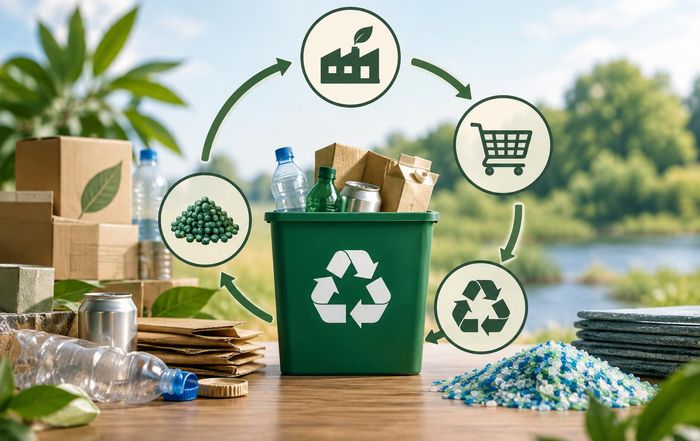
How Extended Producer Responsibility Is Changing Recycling
Extended Producer Responsibility, usually shortened to EPR, is reshaping recycling by shifting part of the cost and responsibility for packaging and products away from taxpayers and local governments and back toward the companies that place those materials on the market. That sounds simple, but in practice it changes how recycling systems are funded, what gets collected, how packaging is designed, and who is accountable when recycling rates stall. For readers trying to understand why recycling rules are changing in so many places, EPR is one of the most important policy ideas to know.
The basic logic is straightforward: if producers help pay for the collection, sorting, and processing of the materials they sell, they have a stronger incentive to reduce waste, make packaging easier to recycle, and support better end markets for recovered materials. The concept has been discussed for decades and is now being built into policy in more countries, including parts of Europe, North America, and Asia. Organizations such as the OECD, the UN Environment Programme, and the European Commission have all played major roles in shaping the policy conversation, while national regulators are turning broad principles into practical rules that affect households, municipalities, and brands.
Why EPR matters to recycling systems
Traditional recycling systems often depend on a patchwork of municipal budgets, commodity markets, and consumer participation. When markets for recovered paper, plastic, glass, or metal weaken, local authorities can end up absorbing more of the cost. That creates a structural problem: the people who design and sell packaging are usually not the ones paying most of the bill for what happens after the product is used. EPR tries to correct that imbalance by making producers financially responsible, at least in part, for the post-consumer life of their packaging or products.
This matters because recycling is not just a question of whether people place items in the right bin. It is also a systems problem involving collection trucks, sorting facilities, contamination, resale markets, labels, and product design. When producers are involved financially, they can influence those upstream decisions. That can mean fewer mixed materials, clearer labeling, less unnecessary packaging, and more standardized formats that are easier for recyclers to process. It can also mean more stable funding for local recycling services, which is especially important for municipalities that have struggled with volatile commodity prices and rising operational costs. For readers interested in the broader policy context, Eco Natur's coverage of sustainability and recycling helps show how EPR fits into wider waste-reduction efforts.
The policy is not limited to packaging, either. In some jurisdictions, EPR applies to electronics, batteries, textiles, tires, and other product categories. The common thread is that the producer is expected to help manage the environmental impact of the item after sale. That can support better collection infrastructure and reduce the likelihood that valuable materials are landfilled, incinerated, or exported without adequate oversight.
What changes in practice for households and local governments
For many households, the most visible change is not a new recycling bin but a more consistent system behind the scenes. EPR programs can fund better curbside collection, expanded drop-off networks, clearer public education, and improved sorting infrastructure. In some areas, that may eventually translate into simpler recycling instructions and fewer "wish-cycling" mistakes, because the system itself becomes more standardized and better financed. The goal is not merely to collect more material, but to collect cleaner material that can actually be turned into new products.
Local governments often benefit from a clearer funding stream, but the transition can be complicated. Municipalities may need to renegotiate contracts, adjust collection routes, or align with new reporting requirements. Some systems also shift responsibility for public-facing communication to producer organizations or stewardship bodies, which can improve consistency but may reduce local flexibility. Canada's provincial EPR systems, for example, have shown that implementation details matter as much as policy design, because collection models, fee structures, and service standards can differ significantly from one jurisdiction to another.
In the United States, the policy is evolving unevenly. States such as Oregon and Colorado have moved forward with packaging EPR laws, while other states are still debating the right approach. That patchwork creates both opportunity and complexity. It can push companies to redesign packaging for broader compliance, but it can also create a fragmented regulatory landscape that is harder for national brands and recycling operators to navigate. For readers following waste policy, Eco Natur's plastic-free and zero-waste sections connect naturally to this shift, because EPR often encourages the same upstream reduction goals that consumers are trying to support at home.
The design incentive is one of the biggest shifts
One of the most important effects of EPR is that it changes packaging design decisions before products ever reach a shelf. If producers must pay more for difficult-to-recycle materials, they have a reason to simplify. That can mean fewer composite materials, more recyclable mono-material formats, less unnecessary colorant or decoration, and labels that are easier for sorting systems to read. It can also encourage companies to reduce packaging weight altogether, which lowers transport emissions and material use.
This design incentive is powerful because it reaches beyond end-of-pipe recycling. A recycling plant cannot easily fix a package that was designed to be confusing, contaminated, or mechanically incompatible with existing sorting systems. EPR makes design part of the policy conversation instead of leaving it to voluntary corporate commitments. In the European Union, where packaging policy is increasingly tied to recyclability and waste reduction goals, the direction of travel is clear: materials that are hard to recover are likely to face more pressure, while formats that fit established recycling streams are likely to be favored. The European Environment Agency has repeatedly highlighted the need to move from linear consumption toward more circular systems, and EPR is one of the main tools being used to do that.
That said, design incentives only work if fee structures are credible and specific enough to reward better choices. If producers pay roughly the same regardless of whether packaging is easy or difficult to recycle, the policy loses much of its force. Well-designed EPR systems therefore depend on "eco-modulated" fees, meaning charges that vary according to recyclability, material choice, or recycled content. That is where policy design becomes especially important, and why regulators often consult technical bodies, industry groups, and waste experts before finalizing rules.
The economics: who pays, and what it changes
EPR is often described as a "producer pays" model, but the economics are more nuanced. Producers may absorb some costs, pass some along to consumers, and invest some savings into packaging redesign or operational changes. The exact distribution depends on market conditions, competition, and how the policy is structured. What EPR does change is the default assumption that municipalities should shoulder the largest financial burden for packaging waste.
This is why business groups, environmental organizations, and local governments often see EPR differently. Many environmental advocates support it because it internalizes costs that were previously externalized to the public. Many municipalities support it because it can stabilize budgets and improve service quality. Some producers support it because it creates a more predictable framework than a patchwork of local rules. Others are concerned about compliance costs, administrative complexity, and the risk that fees may be set too broadly or too high.
The policy can also affect the economics of recycled materials. If EPR funds better collection and sorting, recyclers may receive cleaner feedstock and more reliable volumes. That can improve the quality and consistency of recovered materials, which matters for paper mills, plastic reprocessors, and manufacturers using recycled inputs. But the market still depends on demand. Without buyers for recycled content, collection alone does not guarantee a circular outcome. That is why EPR is increasingly discussed alongside recycled-content mandates, procurement rules, and broader circular-economy policies. The World Economic Forum and Ellen MacArthur Foundation have both helped popularize the idea that waste policy and product design need to be aligned if circular systems are to scale.
Where the policy is gaining ground
EPR is no longer a niche environmental idea. It is becoming mainstream policy in multiple regions, though not in identical forms. The European Union has long been influential in packaging and waste legislation, and its member states have used EPR-style systems for years. In 2026, the policy conversation in Europe is increasingly focused on harmonization, recyclability standards, and how to make collection systems more consistent across borders. That matters because fragmented national rules can undermine the efficiency gains EPR is supposed to create.
Outside Europe, momentum is growing in North America and parts of Asia-Pacific. In the United States, state-level action is likely to shape the next phase of packaging policy more than federal law in the near term. In Canada, provincial programs continue to expand and mature. In countries such as Japan and South Korea, producer responsibility has been part of waste policy for years, though the details differ by material and product type. Internationally, the policy is also being discussed in the context of the global plastics problem, especially as governments look for practical tools to reduce leakage, improve recovery, and finance better waste management.
For readers interested in the intersection of policy and business, Eco Natur's sustainable business and economy sections are useful lenses here. EPR is not just an environmental regulation; it is a market-shaping mechanism. It changes incentives for packaging suppliers, consumer brands, logistics providers, municipalities, and recyclers all at once.
The limits and criticisms are real
EPR is not a cure-all. If systems are poorly designed, producers may pay fees without seeing meaningful improvements in recycling outcomes. If rules are too broad, they can become administratively burdensome. If enforcement is weak, free riders can avoid paying while responsible companies bear the cost. If collection infrastructure is inadequate, more funding alone will not solve contamination, low capture rates, or poor end markets. And if fees are not tied closely enough to material performance, the policy may generate revenue without driving better design.
There is also a legitimate debate about fairness. Some critics argue that consumers ultimately pay higher prices if businesses pass through the costs, which is often true to some degree. Others worry that small businesses may struggle with reporting and compliance, especially if they sell across multiple jurisdictions. These concerns do not necessarily undermine EPR, but they do mean that implementation needs to be carefully calibrated. Good policy design usually includes phased rollouts, clear reporting thresholds, harmonized definitions, and transparent fee-setting so that the system remains workable.
A further challenge is that recycling performance is often measured too simplistically. A program can collect large volumes yet still fail to produce high-quality recycled material. EPR works best when it is paired with metrics that look beyond collection tonnage to actual recyclability, contamination rates, recycled-content uptake, and the economic viability of end markets. Without those safeguards, the policy can reward appearance over results.
What to watch next
The next phase of EPR will likely be defined less by whether governments adopt it and more by how well they implement it. The most important questions are becoming increasingly technical: Which materials are covered? How are fees modulated? Who runs the system? How are local governments reimbursed? What standards define recyclability? How will compliance be enforced across borders and across online marketplaces? Those details determine whether EPR becomes a meaningful driver of circularity or just another layer of waste regulation.
For consumers, the practical takeaway is that recycling is becoming less of a standalone household task and more of a shared responsibility across the product lifecycle. For businesses, the message is that packaging decisions now have policy consequences, not just marketing ones. And for municipalities, EPR offers a chance to improve recycling services without carrying the full financial burden alone, provided the rules are designed well enough to support that outcome.
The policy is still evolving, but its direction is clear: recycling is moving from a system that asks households to sort waste at the end of the chain to one that increasingly asks producers to help design, fund, and manage the whole chain. That shift may be the most important change in recycling policy in years, because it addresses the problem at the point where many waste decisions are actually made.
