
Wildlife Corridors and Highway Crossings: Re-Connecting Nature in a Fragmented World
Reimagining Infrastructure for a Living Planet
The global conversation on sustainability has moved decisively beyond carbon accounting and energy transitions to confront a quieter but equally existential crisis: the fragmentation of habitats by roads, railways and urban expansion. For the community around eco-natur.com, which has long focused on sustainable living, biodiversity and wildlife, the rise of wildlife corridors and highway crossings represents one of the most concrete, measurable and hopeful responses to this challenge.
Across North America, Europe, Asia, Africa and beyond, a new generation of ecologists, engineers, planners and business leaders is re-designing transport infrastructure so that it no longer functions as a near-impenetrable barrier to animal movement. Instead, it is increasingly seen as a permeable system that can be integrated into broader landscape connectivity strategies. Learn more about how global conservation science is evolving through organizations such as IUCN and WWF, which have placed connectivity and landscape-scale planning at the heart of their biodiversity agendas.
The Hidden Cost of Roads: Fragmentation, Collisions and Declining Biodiversity
Modern economies have been built on the rapid movement of people and goods, with dense road networks underpinning global trade and regional development. Yet, as research synthesized by the IPBES global assessment has shown, this infrastructure has come at a considerable ecological cost. Highways, secondary roads and access tracks carve forests, grasslands and wetlands into isolated patches, restricting the ability of wildlife to migrate, find mates, access food and adapt to shifting climate zones.
In the United States, studies by the U.S. Federal Highway Administration estimate that vehicle collisions kill one to two million large animals annually, with far higher numbers for smaller species that rarely appear in official statistics. Similar patterns are seen in Europe, where data compiled by European Environment Agency highlight linear infrastructure as a major driver of habitat fragmentation, particularly in densely populated regions such as Germany, the Netherlands, the United Kingdom and northern Italy. These impacts are not confined to high-profile mammals; amphibians, reptiles, insects and ground-nesting birds are all affected, leading to subtle but profound changes in ecosystem structure.
For businesses and policymakers, the implications extend beyond conservation ethics. Collisions with large mammals carry substantial economic costs in vehicle damage, healthcare, lost productivity and insurance claims. In countries such as Canada, Sweden and Norway, where moose and deer are abundant, wildlife-vehicle collisions are recognized as a significant public safety issue. Understanding this broader context is essential for organizations seeking to align their strategies with sustainable business practices and long-term risk management.
What Are Wildlife Corridors and Highway Crossings?
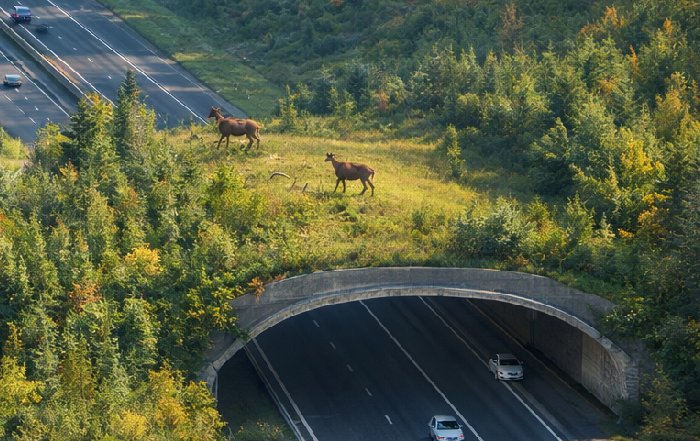
Wildlife corridors are continuous or semi-continuous stretches of habitat that allow animals to move between larger core areas, such as protected reserves, mountain ranges or coastal ecosystems. They may follow river valleys, hedgerows, forest belts, agricultural mosaics or restored urban greenways. Highway crossings are engineered structures-overpasses, underpasses, culverts and retrofitted bridges-designed specifically to enable animals to cross roads safely, often in conjunction with fencing and habitat enhancements that guide them toward these safe passages.
The most iconic examples are large vegetated overpasses, such as those seen in Canada's Banff National Park or the new overcrossing spanning the U.S. Route 101 near Los Angeles, which is being developed in partnership with organizations including National Wildlife Federation. In the Netherlands, a country whose dense transport network has long challenged conservation planning, a sophisticated system of "ecoducts" and amphibian tunnels has been implemented to reconnect fragmented habitats. Similar initiatives can be found in France, Germany, Switzerland and the United Kingdom, where transport agencies collaborate with conservation NGOs to integrate connectivity into road design.
From a technical perspective, effective crossings are carefully tailored to local species and landscapes. Large carnivores such as wolves, lynx and bears may prefer wide, vegetated overpasses with minimal human disturbance, while deer and elk can adapt to a range of structures if visibility and escape options are adequate. Smaller mammals, reptiles and amphibians often use underpasses, culverts or specially designed tunnels. The U.S. National Park Service and Parks Canada have documented decades of monitoring data showing that, when designed and located appropriately, such structures can reduce wildlife-vehicle collisions by more than 80 percent and restore movement patterns across previously impassable highways.
Science-Driven Design: Data, Monitoring and Adaptive Management
What distinguishes the most successful wildlife corridor projects in 2026 is their reliance on rigorous science, long-term monitoring and adaptive management. Conservation biologists use GPS telemetry, camera traps and genetic analysis to understand how animals move through landscapes, where bottlenecks occur and which habitats are most critical for connectivity. This evidence informs the placement and design of crossings, ensuring that investments are targeted where they will deliver the greatest ecological and safety benefits.
Institutions such as Smithsonian Conservation Biology Institute, Wildlife Conservation Society and leading universities across Europe, North America and Asia have developed sophisticated models that integrate land-use change, climate projections and species behavior. These models help planners in countries from Germany and the United Kingdom to Japan and South Korea prioritize corridor routes that will remain viable as temperatures rise and precipitation patterns shift. Learn more about how climate-resilient conservation planning is evolving through resources provided by UNEP and other international bodies.
Monitoring does not end once a crossing is built. Camera traps, track pads, genetic sampling and collision data are used to assess whether animals are actually using the structures, whether fencing is effective in guiding them and whether additional modifications are needed. This adaptive approach mirrors best practices in sustainability more broadly, where continuous improvement and feedback loops are essential to ensure that initiatives remain effective over time.
Global Perspectives: Regional Leadership and Emerging Markets
Although the underlying ecological principles are universal, the implementation of wildlife corridors and highway crossings varies across regions, reflecting differences in governance, funding, landscape context and public awareness.
In North America, Canada and the United States have been early leaders in large-scale connectivity planning. The Yellowstone-to-Yukon initiative, supported by numerous partners including Y2Y Conservation Initiative, exemplifies a continental approach that links protected areas across multiple jurisdictions. State and provincial transport agencies increasingly integrate wildlife considerations into road upgrades, supported by federal guidance and research. In the United States, the Bipartisan Infrastructure Law and related policies have created new funding streams for wildlife crossings, aligning transportation investment with biodiversity and safety goals.
In Europe, the concept of a connected "green infrastructure" network is embedded in the EU Biodiversity Strategy, with member states such as Germany, France, the Netherlands, Sweden and Spain incorporating ecological corridors into spatial planning. Switzerland and Austria have pioneered alpine connectivity projects that address both wildlife conservation and climate adaptation, while the United Kingdom has begun to integrate nature recovery networks into local development plans. These efforts resonate strongly with the cross-border perspective embraced by eco-natur.com, whose readers span Europe, North America, Asia, Africa and South America.
In the Asia-Pacific region, countries such as Australia and New Zealand are adapting corridor concepts to unique fauna and landscapes, from kangaroo crossings and glider canopy bridges to fish passages in river systems. In Southeast Asia, where rapid infrastructure expansion intersects with some of the world's richest biodiversity, initiatives in Thailand, Malaysia and Indonesia are beginning to demonstrate how highway design can mitigate impacts on elephants, tigers and primates. Learn more about regional conservation priorities through ASEAN Centre for Biodiversity and related organizations. China, South Korea and Japan are also investing in ecological restoration and corridor planning as part of broader national strategies to improve environmental quality and public health.
In Africa and South America, where large-scale wildlife migrations and pastoralist movements are central to ecological and cultural systems, corridors are increasingly recognized as essential for balancing development with conservation. Projects linking protected areas in Kenya, Tanzania, South Africa and Namibia, as well as initiatives connecting Amazonian reserves in Brazil, Colombia and Peru, highlight the potential for transboundary cooperation. As these regions continue to urbanize and expand their transport networks, integrating connectivity early in the planning process will be critical to avoid the costly retrofits that many industrialized countries now face.
Business, Economy and the Case for Investment
For the business-oriented audience of eco-natur.com, the economic rationale for wildlife corridors and highway crossings is as important as their ecological justification. Road agencies, insurers, logistics companies and investors increasingly recognize that wildlife-vehicle collisions represent a systemic risk, particularly in regions where large mammals are common. Economic analyses compiled by the OECD and national transport ministries show that the cost of building effective crossings is often offset within a decade by reduced collision-related expenses, especially when structures are integrated into new road projects rather than retrofitted.
From a broader economy perspective, preserving biodiversity and ecosystem connectivity underpins sectors as diverse as agriculture, forestry, tourism and pharmaceuticals. Pollination, pest control, water regulation and cultural services all depend on functioning ecosystems. For companies committed to environmental, social and governance (ESG) excellence, supporting connectivity projects can demonstrate leadership on nature-related risks and opportunities, aligning with emerging frameworks such as the Taskforce on Nature-related Financial Disclosures. Learn more about how sustainable finance is evolving through platforms such as UN Principles for Responsible Investment, which increasingly emphasize biodiversity alongside climate.
There is also a reputational dimension. Infrastructure developers that proactively integrate wildlife crossings and corridors into their projects can differentiate themselves in competitive markets, particularly in regions such as the European Union, the United Kingdom and Canada where public expectations around environmental performance are high. For multinational corporations operating across continents-from North America and Europe to Asia, Africa and South America-partnering with local conservation organizations and indigenous communities on connectivity initiatives can strengthen social license to operate and reduce conflict.
Integrating Corridors into Sustainable Living and Urban Design
Wildlife corridors are not limited to remote wilderness areas or national parks; they are increasingly relevant to the urban and peri-urban environments where most of the world's population now lives. The concept of sustainable living that underpins eco-natur.com naturally extends to how cities and suburbs are designed, including the way they interact with surrounding habitats and species.
Green belts, riverfront parks, rooftop gardens, hedgerows and tree-lined streets can all contribute to urban connectivity for birds, insects and small mammals. In metropolitan regions such as London, Berlin, Vancouver, Singapore and Melbourne, planners are experimenting with "green corridors" that link parks, nature reserves and community gardens, enhancing both biodiversity and human well-being. Learn more about the health benefits of urban nature through research summarized by the World Health Organization, which highlights the role of green spaces in reducing stress, improving air quality and encouraging physical activity.
These urban corridors intersect with other sustainability themes that are central to eco-natur.com, including zero-waste lifestyles, plastic-free choices and recycling. Reducing plastic pollution, for example, directly benefits wildlife that move along river and coastal corridors, from seabirds in the North Atlantic and Pacific to freshwater turtles in Southeast Asia and Africa. Similarly, regenerative and organic food systems can create mosaic landscapes that function as corridors for pollinators and farmland birds, particularly in countries such as France, Italy, Spain, Germany and the Netherlands where agricultural intensification has historically fragmented habitats.
Governance, Policy and Cross-Sector Collaboration
Effective wildlife corridors and highway crossings rarely emerge from isolated efforts; they require coordinated governance across multiple agencies, sectors and jurisdictions. National transport ministries, environmental agencies, regional planning authorities, municipalities and private developers must align their objectives, budgets and timelines. International frameworks such as the Convention on Biological Diversity and the post-2020 Global Biodiversity Framework emphasize connectivity as a key target, encouraging countries to incorporate corridors into their national biodiversity strategies and action plans.
In practice, this translates into legal and policy instruments such as ecological network designations, mandatory environmental impact assessments, mitigation hierarchies and financial incentives for nature-positive infrastructure. Countries including Germany, France, Sweden, South Africa and Brazil have experimented with various combinations of regulatory and voluntary measures to promote connectivity. In the United States and Canada, state, provincial and tribal governments often play a central role, particularly where wildlife migrations cross multiple land tenures and cultural landscapes.
For businesses and investors, understanding this policy landscape is essential to anticipate regulatory changes and identify partnership opportunities. Collaboration with NGOs, research institutions and local communities can help ensure that projects are grounded in robust science and social legitimacy. Learn more about best practices in multi-stakeholder governance through resources offered by World Resources Institute and similar organizations that bridge science, policy and business.
Trust, Transparency and the Role of Independent Platforms
As interest in wildlife corridors and highway crossings grows, so does the need for trustworthy, accessible information. For many individuals and organizations, independent platforms such as eco-natur.com play a crucial role in translating technical research into practical insights that inform lifestyle choices, business strategies and policy debates. By curating content on sustainability, wildlife, lifestyle and health, the site provides a bridge between scientific expertise and everyday decision-making.
Trustworthiness in this context depends on several factors: reliance on reputable scientific sources, transparency about uncertainties and trade-offs, and a commitment to continuous updating as new evidence emerges. Organizations such as IPCC and IUCN set standards for evidence-based reporting on climate and biodiversity, but it is through platforms like eco-natur.com that this knowledge becomes relevant to households choosing plastic-free products, companies designing sustainable supply chains and communities advocating for safer, more wildlife-friendly roads.
By highlighting successful case studies from around the world-from wildlife overpasses in Canada and the United States to green infrastructure networks in Europe and emerging initiatives in Asia, Africa and South America-the platform can inspire replication and adaptation. It can also connect readers to practical resources on recycling, renewable energy and sustainable business, reinforcing the idea that habitat connectivity is one dimension of a broader sustainability journey.
Why Wildlife Needs Highway Crossings Corridors as a Backbone of a Nature-Positive Future
As the world moves deeper into the 2020s, the concept of a "nature-positive" economy is gaining traction, supported by governments, businesses and civil society organizations across continents. In this emerging paradigm, wildlife corridors and highway crossings are not peripheral add-ons but foundational elements of resilient landscapes and infrastructure systems. They embody the principle that economic development and ecological integrity can be reconciled through thoughtful design, long-term planning and cross-sector collaboration.
For the global audience of eco-natur.com-from the United States, Canada and the United Kingdom to Germany, France, Italy, Spain, the Netherlands, Switzerland, China, Japan, South Korea, Australia, New Zealand, South Africa, Brazil, Malaysia, Thailand, Singapore, the Nordic countries and beyond-the challenge and opportunity lie in ensuring that connectivity becomes a standard expectation rather than an exceptional innovation. This means advocating for policies that prioritize corridors, supporting businesses that invest in nature-positive infrastructure, and adopting lifestyles that reduce pressure on habitats, whether through plastic-free choices, zero-waste practices or nature-friendly diets.
Those seeking to deepen their understanding of global trends can explore analyses from World Bank and United Nations Development Programme, which increasingly integrate biodiversity and connectivity into development planning. Yet the most powerful insights often emerge at the intersection of global frameworks and local experience: the farmer in France restoring hedgerows that double as corridors, the transport engineer in Sweden designing elk-safe overpasses, the community group in Brazil advocating for riparian buffers along a new highway.
In this sense, wildlife corridors and highway crossings are more than engineering solutions; they are symbols of a broader shift in how societies value and relate to the natural world. They demonstrate that with expertise, collaboration and a commitment to evidence-based action, it is possible to re-connect fragmented landscapes and rebuild the ecological networks on which all economies and communities ultimately depend. As eco-natur.com continues to explore global sustainability challenges and solutions, these living bridges between habitats will remain a central, inspiring example of what a truly integrated, nature-respecting future can look like.
