
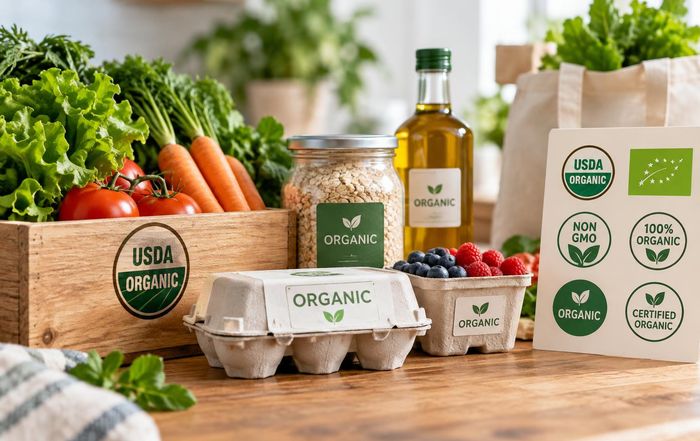
Organic Food Labels Explained for Everyday Shoppers
Organic labels are meant to tell shoppers something specific about how food was produced, but the meaning is not always obvious at a glance. A package may say "organic," "made with organic ingredients," or display a certification seal, and each of those signals something different. For everyday shoppers trying to balance health, price, and environmental concerns, the most useful question is not simply whether a product is organic, but what standard it actually meets and how much of the claim is independently verified. That distinction matters because organic rules are regulated differently across countries, and marketing language can sometimes blur the line between certified claims and general eco-friendly branding. If you are already interested in sustainable living, understanding these labels is one of the simplest ways to make more informed food choices without getting lost in packaging language.
What "organic" usually means on a food package
In most major markets, "organic" is not just a style of farming; it is a regulated production standard. The details vary, but the core idea is similar: crops are grown without most synthetic pesticides and fertilizers, and livestock are raised under rules that restrict routine antibiotics, growth hormones, and certain feed practices. In the United States, the US Department of Agriculture oversees the National Organic Program, while the European Commission sets the framework for organic production across the EU. The UK government maintains its own post-Brexit system, and countries such as Canada, Japan, and Australia have their own certification rules as well. The practical result is that an organic label should indicate a production method backed by a standard, not just a vague health promise.
That said, organic does not mean pesticide-free, chemical-free, or automatically healthier in every respect. Organic farmers may still use approved natural or low-toxicity inputs, and they still face the same realities of weather, pests, transport, and storage as conventional producers. The label is better understood as a description of farming and processing rules than as a blanket guarantee about nutrition, taste, or environmental impact. For readers comparing food choices through a wider sustainability lens, it can help to pair organic purchasing decisions with broader habits such as zero waste shopping, recycling, and choosing less heavily packaged products when possible.
The labels shoppers are most likely to see
The most important distinction is between a fully certified organic product and one that contains some organic ingredients but does not qualify for the strongest label. In the U.S., "100% organic" means every ingredient and processing aid must meet organic rules, apart from a few minor exceptions such as water and salt. "Organic" generally means at least 95% of the ingredients are organic, while "made with organic ingredients" usually means at least 70% are organic. Similar tiered systems exist in other countries, though the wording and thresholds differ. The presence of a certification seal is usually more meaningful than a loose front-of-pack claim because it implies third-party verification rather than a self-described marketing phrase.
This is where shoppers should slow down and read the details. A cereal box may highlight organic oats, but if the rest of the ingredients are conventional, the product may not be equivalent to a fully organic item. The same applies to snacks, sauces, and beverages that use organic ingredients as a branding cue while still relying on non-organic components. If you are trying to understand the broader food system behind these labels, it can also be useful to explore related topics such as organic food, sustainability, and health, because the label sits at the intersection of farming practice, nutrition expectations, and environmental values.
Why certification matters more than the word itself
Certification is what turns "organic" from a general claim into a regulated standard. Independent certifiers inspect farms, processors, handlers, and sometimes retailers to check records, inputs, segregation practices, and traceability. In the U.S., the National Organic Program is the core federal framework; in the EU, official organic logos and control bodies perform a similar role; and in the UK, approved control organizations certify products under national rules. Internationally recognized organizations such as IFOAM Organics International help explain how organic systems are defined and harmonized, even though local laws still differ. The common thread is that a valid organic claim should be auditable from farm to shelf.
For shoppers, the practical takeaway is simple: look for a recognized seal or certifier name, not just a design that uses leaves, earth tones, or words like "natural" and "eco." Those design choices can be suggestive without carrying the same legal meaning. This is especially important in categories where packaging is crowded with environmental messaging. A product can be ethically positioned, locally sourced, or low-waste without being organic, and it can be organic without being especially local or minimally packaged. Those are related but separate claims, which is why shopping decisions often work best when they are tied to a broader understanding of sustainable business and supply-chain transparency rather than a single front-label word.
Common misconceptions about organic food
One of the most persistent misconceptions is that organic automatically means healthier. The evidence is more nuanced. Some studies find lower pesticide residues on organic produce and small differences in certain nutrients for some foods, but nutrition is influenced by many variables, including variety, freshness, storage, and overall diet. Major health bodies such as the World Health Organization and Harvard University emphasize that eating more fruits, vegetables, whole grains, and legumes matters more than relying on a label alone. Organic can be a reasonable preference, but it should not be mistaken for a substitute for dietary quality.
Another misconception is that organic always means environmentally superior in every case. Organic systems can reduce certain synthetic inputs and may support soil health or biodiversity, but yields can be lower in some contexts, land use can be higher, and transportation or refrigeration can still create a significant footprint. The environmental picture depends on the crop, region, and farming method, which is why a simple "organic versus conventional" comparison often misses the bigger issue. If you are interested in how farming choices affect ecosystems, the related areas of biodiversity and wildlife provide useful context for understanding why agricultural standards matter beyond the individual shopping basket.
How to read labels without overcomplicating the trip to the store
For most shoppers, the best approach is to treat organic labeling as one factor among several. Start by checking whether the product carries a recognized certification mark, then look at the ingredient list, country of origin, and packaging claims. If the item is a single-ingredient food such as apples, oats, or milk, the organic claim is usually easier to interpret than on a highly processed snack with many components. For processed foods, the percentage of organic ingredients and the presence of non-organic additives matter more than the headline wording. In practice, the more processed the product, the more important it is to read beyond the front panel.
It also helps to separate values. Someone may prioritize organic because they want fewer synthetic inputs in farming, while another shopper may care more about local sourcing, affordability, animal welfare, or plastic reduction. Those priorities do not always align neatly. A certified organic item imported from far away may fit one value but not another, while a local non-organic product may better support regional producers or lower transport emissions. For followers who like to compare food choices with broader lifestyle goals, lifestyle and global perspectives can be useful reminders that food decisions sit inside larger systems, not just on a supermarket shelf.
When organic may be worth the extra cost
Organic food often costs more because certification, separate handling, and lower yields can raise production expenses. Whether that premium is worth paying depends on what the shopper values most. Some people choose organic for pesticide concerns, others for animal welfare standards, and others because they want to support farming systems that avoid routine synthetic inputs. In households with tight budgets, it can make sense to prioritize organic for products eaten with the skin on or for items purchased frequently, while buying conventional versions of other foods. There is no universal rule that every organic product is worth the premium for every household.
A more balanced strategy is to think in categories rather than absolutes. Staples that are heavily consumed, fresh produce with thin skins, and products where certification strongly aligns with personal values may be the most sensible places to spend more. Meanwhile, shoppers who are trying to reduce waste or improve overall sustainability may decide that buying fewer packaged snacks, choosing seasonal produce, or reducing food waste matters more than switching every item to organic. That kind of trade-off is often more realistic and more effective than trying to make every purchase perfectly match every ideal.
The bigger picture behind the label
Organic labeling is not just a consumer cue; it is part of a wider debate about how food should be grown, regulated, and marketed. Supporters see organic standards as a way to limit certain agricultural inputs, encourage more transparent production, and reward farms that adopt stricter practices. Critics argue that the label can be expensive, inconsistently understood, or oversold as a proxy for health and environmental virtue. Both views contain some truth, which is why the most useful consumer stance is usually cautious rather than absolute. Organic is best seen as a verified production standard with real benefits in some contexts, not as a magic word that settles every question about food quality.
For everyday shoppers, the goal is not to decode every certification body in the aisle. It is to know enough to distinguish meaningful claims from marketing, and to make choices that fit personal priorities and budget. If a product is certified organic, that tells you something concrete about how it was produced. If it only looks eco-friendly, you may need to read more carefully. And if your broader interest is in making food choices that support a cleaner, more responsible lifestyle, organic labels are most useful when they are considered alongside packaging, sourcing, seasonality, and the rest of the everyday decisions that shape what ends up in the kitchen.
