
Recycling Tips for Shared Homes and Apartment Buildings
Rethinking Recycling in High-Density Living
In shared homes and apartment buildings, recycling is no longer a marginal lifestyle choice; it is rapidly becoming a defining feature of responsible urban living. As cities across North America, Europe, Asia, Africa, and South America grow denser, more households depend on communal spaces, shared bins, and building-wide systems to manage waste. In this context, the work of sites like this has become increasingly important, because practical, trustworthy guidance can mean the difference between a well-functioning recycling system and one that quietly collapses under contamination and confusion.
Researchers and policy makers agree that recycling alone will not solve the global waste crisis; reducing and reusing materials must come first. Yet effective recycling remains a critical bridge between current consumption patterns and a more circular economy. Urban and multi-family buildings are central to that bridge. According to data from organizations such as the OECD and the World Bank, municipal solid waste generation is highest in urbanized, higher-income regions, where apartment living is common, and where shared infrastructure offers both opportunity and complexity. When residents coordinate, shared buildings can outperform detached homes in recycling rates, but when systems are poorly designed or communication is weak, contamination can negate entire loads of recyclables.
For eco thinkers, who are often already committed to sustainable living and lower-impact lifestyles, the challenge is not whether to recycle, but how to make recycling work in environments where responsibility is shared and rules are sometimes unclear. This article explores evidence-based strategies that residents, building managers, and community leaders can use to transform shared homes and apartment complexes into reliable recycling hubs, while also advancing broader goals such as zero waste, plastic reduction, and sustainable business practices.
Understanding How Recycling Systems Work in Multi-Family Housing
Recycling in shared residences is shaped by a mix of municipal policies, private waste haulers, building management decisions, and resident behavior. In many cities in the United States, Canada, and parts of Europe, local authorities set the rules for what can be recycled and how, while in other regions private companies play a larger role. The U.S. Environmental Protection Agency explains that multi-family recycling programs often face lower participation and higher contamination than single-family programs, not because residents care less, but because they have less control over infrastructure and information. Similar patterns have been documented in cities like London, Berlin, and Sydney, where local councils and housing providers must coordinate to keep programs effective.
In apartment buildings, materials usually travel through several stages: from individual units to shared chute rooms or collection points, then to central bins in parking areas or courtyards, and finally to trucks that transport them to material recovery facilities. At each stage, design and communication either support or undermine correct sorting. Studies from organizations such as WRAP UK and Zero Waste Europe highlight that when signage is confusing or bins are hard to access, residents are more likely to use whichever container is most convenient, even if they are committed to sustainability in principle.
For clever folks, this means that effective recycling begins with understanding the specific system that governs their building. Local rules vary widely; a carton that is recyclable in Stockholm may be treated as residual waste in parts of the United States, while glass collection can be universal in one city and limited in another due to cost or safety concerns. Checking municipal guidance from trusted sources such as official city websites, the European Environment Agency, or national environment ministries is essential before making assumptions. When reliable sources conflict, residents can often obtain clarification directly from their local council or waste hauler, which is preferable to relying on generic advice that may not match local conditions.
Building a Culture of Shared Responsibility
In shared homes and multi-family buildings, recycling success is as much about culture as it is about containers. Research from organizations such as BehaviorWorks Australia and the Ellen MacArthur Foundation shows that people are more likely to sort correctly when they feel part of a community effort and when social norms support pro-environmental behavior. This is particularly relevant in diverse urban buildings where residents may come from different countries with different recycling systems and expectations.
Creating a culture of shared responsibility starts with clear, respectful communication. Tenants and homeowners respond better when information is framed positively and linked to values they care about, such as protecting local wildlife, reducing pollution, or supporting a healthier lifestyle. Eco Natur can play a pivotal role here by providing accessible explanations of why recycling matters, how it connects to biodiversity protection, and what it means for the long-term resilience of cities and communities.
Residents' associations, building managers, and sustainability-minded tenants can collaborate to develop simple, shared goals-such as reducing contamination rates, increasing participation, or introducing new streams like food scraps for composting where available. Regular reminders, friendly feedback, and visible success stories, such as reductions in general waste or improvements reported by the local hauler, help sustain engagement. While formal studies on the impact of feedback in apartment recycling are still emerging, evidence from community-based social marketing indicates that feedback loops are powerful drivers of behavior change when combined with practical support.
Designing Effective Recycling Setups Inside Apartments
For individuals and families living in shared homes or apartments, one of the most practical steps toward reliable recycling is thoughtful interior design. Small kitchens and limited storage can make sorting feel burdensome, especially in older buildings that were not designed with sustainability in mind. Yet modest changes can significantly reduce friction.
Integrating multiple containers into existing cabinetry, using stackable bins, or repurposing sturdy boxes can create a dedicated space for recyclables without sacrificing floor area. Residents can label each container according to local rules-paper and cardboard, plastics and metals, glass, and food scraps where separate collection exists. Research from design and sustainability institutes, including the Centre for Sustainable Design and various university departments, suggests that visual cues such as icons and color coding help reduce sorting errors, particularly in households with children or multiple roommates.
For those who prioritize plastic-free living, setting up a separate container for soft plastics or film, when specialized drop-off points exist, can help prevent these materials from contaminating regular recycling bins. In some regions, large retailers and supermarkets, often guided by commitments tracked by organizations like the Ellen MacArthur Foundation or The Recycling Partnership, host collection points for specific items such as plastic bags or flexible packaging. Where no such options are available, Eco Natur emphasizes that reducing consumption of problematic materials is usually preferable to relying on uncertain recycling pathways.
Navigating Shared Bins, Chutes, and Collection Areas
Once materials leave individual apartments, the shared spaces of a building become critical. Poorly maintained or confusing shared recycling areas can undo careful sorting done inside homes. Studies from municipal waste authorities in cities such as Toronto, Zurich, and Seoul indicate that contamination rates often spike in communal areas where bins are unlabeled, overflowing, or placed far from entrances.
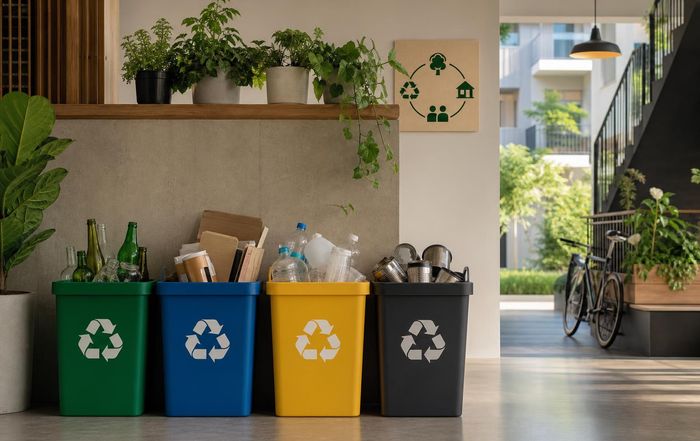
Residents and building managers can collaborate to improve these spaces. Clear signage, ideally using both text and simple imagery, helps residents and visitors understand what belongs in each container. In multilingual buildings, using pictograms or adding translations can reduce misunderstandings. Organizations like Recycle Now in the UK and municipal campaigns in Germany, the Netherlands, and Scandinavia provide downloadable posters and guidance that can be adapted for local use, and these can complement resources curated by us on recycling best practices.
Accessibility is another crucial factor. When recycling bins are closer or easier to reach than general waste containers, participation tends to increase. Conversely, if residents must carry recyclables down multiple flights of stairs or across parking lots while general waste chutes are directly accessible on each floor, even motivated individuals may default to convenience. Advocating for more balanced placement of bins, improved lighting, and regular cleaning can make recycling feel safer and more appealing, particularly for older residents or those returning home late at night.
Reducing Contamination: The Most Important Habit
From the perspective of material recovery facilities and municipal programs, contamination is one of the most persistent challenges in apartment recycling. Contamination occurs when non-recyclable items are placed in recycling bins, or when recyclable materials are soiled with food, liquids, or other substances that make them difficult or impossible to process. Organizations such as The Recycling Partnership in the United States and PlasticsEurope in the EU have repeatedly highlighted contamination as a major barrier to achieving higher recycling rates and better material quality.
For shared homes and apartment buildings, several habits are especially impactful. First, residents are encouraged to follow the principle of "empty, clean, and dry" for most containers, rinsing out food remnants and letting items drain before placing them in the bin. While not every trace of residue must be removed, large amounts of food or liquid can spoil entire batches of paper or cardboard. Second, "wishcycling"-placing questionable items in the recycling in the hope that they will be sorted correctly-is widely discouraged by experts, as it often does more harm than good. Instead, residents are advised to consult local guidance, and when in doubt, treat unknown items as general waste unless a credible source confirms they are accepted.
Plastic films, black plastics, and composite materials such as coffee cups with plastic linings are common sources of confusion. Guidance differs by region and is evolving as technology and policy change, so residents should rely on updated information from municipal sources, national environment agencies such as the U.S. EPA, Environment and Climate Change Canada, or Germany's Umweltbundesamt, and trusted environmental organizations like Greenpeace or the Natural Resources Defense Council, which often provide region-specific explanations. Eco Natur regularly encourages readers to revisit local rules, as systems that were accurate a few years ago may have shifted due to market conditions or new regulations.
Integrating Organics and Food Waste in Shared Buildings
An increasing number of cities in Europe, North America, and parts of Asia are introducing separate collection for food scraps and organic waste, recognizing that organics make up a substantial share of municipal waste and that composting or anaerobic digestion can significantly reduce greenhouse gas emissions. Authorities such as Metro Vancouver, San Francisco's Department of the Environment, and several Scandinavian municipalities have demonstrated that organics collection in multi-family buildings is achievable when residents are given the right tools and information.
In shared homes and apartments, managing food waste can feel challenging due to concerns about odor, pests, and limited space. However, small, sealable countertop caddies, compostable liners where permitted, and frequent emptying into shared organics bins can address many of these issues. Some residents choose to combine municipal programs with personal practices such as home composting on balconies or in shared gardens, provided local regulations and building policies allow it. For people interested in the link between organic waste management, soil health, and organic food systems, resources from organizations like FAO, IFOAM - Organics International, and Rodale Institute provide deeper context on how nutrient cycles connect urban living with agricultural resilience.
When buildings do not yet offer organics collection, sustainability-minded residents can respectfully raise the issue with property managers or housing associations, providing examples from other cities and highlighting potential benefits, including reduced general waste fees where pay-as-you-throw systems exist. Eco Natur often emphasizes that positive, solution-oriented dialogue, backed by credible evidence, tends to be more effective than confrontation when advocating for new sustainability measures.
Moving Beyond Recycling: Redesigning Consumption in Shared Spaces
While this article focuses on recycling, the broader mission of Eco Natur and similar initiatives is to support a shift toward systems where recycling is the last resort rather than the default. Shared homes and apartment buildings are uniquely positioned to pioneer this shift because they naturally foster communal solutions. Shared kitchens, laundry rooms, and storage areas can host initiatives that reduce the need for disposable products and excessive packaging.
Residents can organize borrowing libraries for tools, kitchen appliances, or seasonal items, thereby reducing the volume of goods that eventually require recycling or disposal. In some cities, building-based swap shelves or "free tables" have become informal hubs for reuse, allowing residents to exchange books, household items, or clothing instead of discarding them. These practices align closely with the zero waste principles promoted by organizations like Zero Waste International Alliance and Zero Waste Europe, which stress redesign, reduction, and reuse as foundational strategies.
At the same time, choosing products with minimal or easily recyclable packaging, favoring refill systems, and supporting local businesses that prioritize circular models all contribute to a healthier sustainable economy. Reports from the Ellen MacArthur Foundation, the World Economic Forum, and other thought leaders in the circular economy movement indicate that these consumer choices, when aggregated across buildings and neighborhoods, can send strong market signals that accelerate innovation in packaging and product design.
Recycling as Part of Healthier, Nature-Positive Urban Living
Recycling in shared homes and apartment buildings is not only a technical or logistical issue; it also has implications for health, wellbeing, and the natural world. Reduced waste and better resource management can contribute to cleaner air and water, less litter, and fewer microplastics in urban ecosystems. Organizations such as the World Health Organization and UN Environment Programme have documented links between environmental quality and public health, noting that sustainable waste management is one component of broader strategies to create healthier cities.
For residents concerned with personal and community health, recycling can be integrated into a holistic approach that includes choosing safer materials, reducing exposure to harmful chemicals, and supporting urban green spaces that provide habitat for wildlife. Eco Natur frequently highlights how everyday decisions-from selecting glass over certain plastics to supporting organic and regenerative agriculture-can reduce the burden of pollution on both humans and ecosystems. As cities invest in green infrastructure and biodiversity-friendly design, effective recycling programs can complement these efforts by limiting the flow of waste into rivers, oceans, and natural habitats.
In many regions, citizen-led clean-up initiatives, supported by groups such as Ocean Conservancy, Surfrider Foundation, and local conservation organizations, have shown that when communities come together to remove litter and improve recycling, they also strengthen social bonds and a sense of shared stewardship. Apartment buildings and shared homes can be starting points for such engagement, with residents organizing building-level clean-ups, educational events, or partnerships with neighborhood associations.
The Role of Policy, Technology, and Business in Supporting Residents
While individual and community actions are essential, systemic support from policy, technology, and business is equally important to make recycling in multi-family housing effective and fair. Extended producer responsibility schemes, where manufacturers are required to take financial or physical responsibility for the end-of-life of their products and packaging, are expanding in the European Union, parts of North America, and several Asian countries. These policies, tracked by organizations such as the OECD, aim to improve recycling infrastructure, harmonize labeling, and incentivize better design.
Technological innovations, including optical sorting, AI-assisted material recognition, and improved tracking of waste streams, are gradually increasing the efficiency of recycling facilities. Companies and research institutes documented by sources like Ellen MacArthur Foundation, Fraunhofer Institutes, and various universities are experimenting with ways to handle complex materials and reduce contamination. However, experts caution that technology cannot fully compensate for poorly sorted input; resident participation and accurate separation remain fundamental.
From a business perspective, property management firms, real estate developers, and corporate landlords are beginning to recognize that robust recycling and sustainability features can enhance property value, tenant satisfaction, and brand reputation. Guidance from organizations like GRESB and World Green Building Council encourages building owners to integrate waste management into broader sustainability strategies. For Eco Natur, this intersection of sustainable business practices, resident wellbeing, and environmental responsibility is a key area of ongoing attention, offering opportunities to showcase positive case studies and inspire further action.
How Eco Natur Helps Residents Turn Intentions into Impact!
Throughout the world, from dense urban centers in the United States and the United Kingdom to rapidly growing cities in Asia, Africa, and South America, residents are searching for trustworthy, practical advice on how to live more sustainably in shared spaces. Eco Natur has positioned itself as a supportive guide in this landscape, providing in-depth resources on sustainability, recycling, plastic-free choices, organic food, and related topics that matter to people navigating the realities of modern apartment life.
By combining evidence-based information with an emphasis on positive, achievable steps, Eco Natur helps readers move from concern to action. The platform's focus on global perspectives acknowledges that solutions must be adapted to local contexts, while its commitment to clarity, transparency, and continuous learning reflects the evolving nature of environmental knowledge. As policies shift, technologies advance, and new research emerges, we aim to keep residents informed so that their daily decisions-from how they sort their waste to which products they bring into their homes-align with the best available understanding.
For those living in shared homes and apartment buildings, the path to effective recycling is rarely perfect, but it is always meaningful. Each correctly sorted container, each conversation with a neighbor about improving shared bins, and each decision to reduce unnecessary packaging contributes to a broader cultural transformation. In this decade, when the need for climate action, resource conservation, and biodiversity protection is widely recognized, the collective efforts of apartment dwellers around the world represent a quiet but powerful force for change.
By embracing thoughtful design inside their units, advocating for better systems in their buildings, and supporting policies and businesses that prioritize circularity, residents can help ensure that recycling lives up to its promise as part of a larger shift toward regenerative, nature-positive living. With guidance from hubs like Eco Natur and collaboration across communities, recycling in shared homes and apartment buildings can become not just a routine chore, but a meaningful expression of shared responsibility for the planet.
