
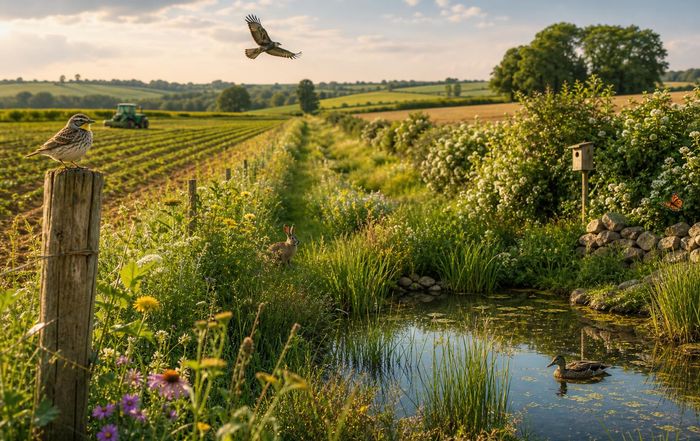
Wildlife Conservation Strategies for Agricultural Landscapes
Rethinking Farmland: From Production Zones to Living Ecosystems
Across the world's agricultural heartlands, a quiet transformation is underway. Fields once viewed solely as engines of food production are increasingly recognised as vital habitats where people, crops and wildlife must coexist. For the ecological and environmentally caring visitors coming to eco-natur.com, this shift resonates deeply with a long-standing conviction: that sustainable living, thriving biodiversity and resilient economies are inseparable.
As food demand grows and climate pressures intensify, agricultural landscapes in North America, Europe, Asia, Africa and South America are under unprecedented strain. Yet at the same time, scientists, farmers, Indigenous communities, businesses and policymakers are demonstrating that well-managed farms can host rich wildlife communities while remaining productive and profitable. This article explores the most promising wildlife conservation strategies for agricultural landscapes, drawing on recent research and practical experience, and highlighting how individuals, communities and companies can support this transition through more sustainable living choices and responsible consumption.
Why Wildlife in Farmland Matters
Farmland now covers roughly half of the world's habitable land, according to analyses by Our World in Data and the Food and Agriculture Organization (FAO). In many regions, particularly in Europe, North America and parts of Asia, agricultural land represents the dominant land use outside of cities. As natural habitats have been cleared or fragmented, agricultural landscapes have become essential refuges for birds, insects, mammals, amphibians and soil organisms.
Conservation biologists and agronomists increasingly emphasise that wildlife protection is not only an ethical or aesthetic concern but also a foundation for resilient food systems. Pollinators such as wild bees, butterflies and hoverflies are crucial for many fruit, vegetable and nut crops, as documented by the Intergovernmental Science-Policy Platform on Biodiversity and Ecosystem Services (IPBES) and the United Nations Environment Programme (UNEP). Predatory insects, birds and bats help control pests, reducing reliance on synthetic pesticides that can harm both biodiversity and human health. Healthy soils, rich in microbial and invertebrate life, support nutrient cycling and water retention, which are vital for climate adaptation.
Studies published in journals like Nature and Science show that landscapes with a mosaic of habitats-hedgerows, flower strips, ponds, woodlots and uncultivated field margins-tend to have higher biodiversity and often more stable yields over time. For readers interested in the interplay between ecology and economy, top resources on sustainable business models and green economy concepts provide additional context on how these ecological benefits translate into long-term value.
From Land Sparing vs. Land Sharing to Integrated Strategies
For years, conservation debates often framed the relationship between farming and wildlife as a choice between "land sparing" and "land sharing." Land sparing advocates argued for intensifying production on some land to free up other areas for strict protection, while land sharing proponents favoured wildlife-friendly farming across larger areas, even with lower yields. Recent research, including syntheses by The Royal Society and the International Union for Conservation of Nature (IUCN), suggests that the most effective approach depends on local conditions, crop types, species at risk and social contexts.
Rather than a rigid dichotomy, many practitioners now aim for integrated strategies that combine protected areas, ecological corridors and high-nature-value farmland with more intensive zones that still respect environmental safeguards. In Europe, for example, the European Union's Common Agricultural Policy (CAP) increasingly incorporates "eco-schemes" that reward farmers for creating habitats and reducing chemical inputs. In the United States, programs under the US Department of Agriculture (USDA), such as the Conservation Reserve Program, pay farmers to retire environmentally sensitive land and restore native vegetation.
This integrated perspective aligns closely with Eco Natur's emphasis on holistic sustainability, where food production, biodiversity, climate and community well-being are treated as interconnected priorities rather than competing objectives.
Habitat Features that Bring Wildlife Back to Fields
One of the most tangible ways to enhance wildlife in agricultural landscapes is to restore habitat diversity. Rather than vast monocultures stretching to the horizon, conservation-oriented farms incorporate a network of semi-natural features that provide nesting sites, shelter, food resources and movement corridors for wildlife.
Hedgerows, tree lines and shelterbelts have long been recognised as important habitats in European and British farmland, and renewed interest is emerging in North America, Australia and parts of Asia. Research by organisations such as the UK Centre for Ecology & Hydrology and BirdLife International shows that well-managed hedgerows support farmland birds, small mammals, pollinators and beneficial insects, while also reducing soil erosion and buffering wind. In regions such as France, Germany and the Netherlands, agri-environment schemes increasingly fund hedgerow restoration, reflecting a broader shift toward landscape-level planning.
Flower strips and wildflower margins along field edges or within large fields are another powerful tool. Studies coordinated by the German Centre for Integrative Biodiversity Research and similar institutions in Switzerland and the United Kingdom report significant increases in pollinator abundance and diversity when diverse native flower mixes are sown and maintained. These strips can also host natural enemies of crop pests, contributing to more ecologically balanced pest management. For nature, loving readers of Eco Natur interested in plastic-free gardening and land care, there is growing guidance on establishing such habitats without synthetic mulches or disposable plastics.
Wetlands, ponds and riparian buffers along streams are critical for amphibians, aquatic insects and waterbirds, as well as for water quality. In many intensive agricultural regions, drainage and channelisation have removed or degraded these habitats. Restoration projects supported by organisations such as Wetlands International and national environmental agencies show that even small ponds and vegetated buffer strips can significantly improve biodiversity while filtering nutrients and sediments that would otherwise pollute rivers and coastal zones.
Woodlots, agroforestry systems and scattered trees also play an important role. The World Agroforestry Centre (ICRAF) and the FAO document how integrating trees with crops or livestock can increase carbon storage, improve microclimates, provide habitat and diversify farm incomes through timber, fruit, nuts and non-timber products. In tropical regions, shade-grown coffee and cocoa systems, when managed with native tree cover, are particularly valuable for birds, bats and insects, as highlighted by research from institutions in Brazil, Colombia and Southeast Asia.
For those exploring broader themes of biodiversity conservation, agricultural habitat restoration illustrates how even small interventions, when replicated across landscapes, can create meaningful networks of living space for wildlife.
Reducing Chemical Pressure: Toward Ecological Pest and Weed Management
Chemical pesticides and herbicides have been central to modern agriculture, but their impacts on non-target species are increasingly well documented. Reports by the European Food Safety Authority (EFSA), the US Environmental Protection Agency (EPA) and independent academic teams have linked certain insecticides, especially some neonicotinoids, to declines in pollinators and aquatic insects, while herbicide overuse can reduce flowering plants and habitat structure.
In response, many farmers and advisors are turning to integrated pest management (IPM) and regenerative practices that rely more on ecological processes. IPM combines careful monitoring of pest populations, use of biological controls such as predatory insects and parasitoids, targeted and reduced chemical applications when necessary, and cultural practices like crop rotation and resistant varieties. The FAO and CABI (Centre for Agriculture and Bioscience International) provide extensive, region-specific guidance on IPM for various crops.
Organic and agroecological farming systems go further by avoiding synthetic pesticides and fertilisers altogether. Long-term comparisons, such as those conducted by the Rodale Institute in the United States and research institutes in Germany and Switzerland, indicate that organic systems can support significantly higher biodiversity, particularly of soil organisms, birds and beneficial insects. While yields can be lower for some crops under certain conditions, improvements in soil health, water retention and resilience to extreme weather are often noted. Readers interested in the intersection of wildlife-friendly farming and human well-being may find the organic food and health resources on eco-natur particularly relevant, as they explore both environmental and nutritional dimensions.
A key message from recent scientific literature is that reducing chemical pressure does not necessarily mean accepting uncontrolled pest damage. Instead, it involves rethinking farm management to work with ecological dynamics, including the role of wild species as allies in maintaining crop health.
Soil Life: The Hidden Wildlife Beneath Our Feet
When discussing wildlife conservation, attention often focuses on visible animals like birds, mammals and butterflies. Yet an enormous share of biodiversity in agricultural landscapes resides in the soil: microbes, fungi, nematodes, earthworms, beetles and countless other organisms. These communities drive nutrient cycling, structure soil aggregates, influence water infiltration and play a role in disease suppression.
Studies compiled by organisations such as the Soil Health Institute and the European Commission's Joint Research Centre show that intensive tillage, heavy machinery, overuse of synthetic fertilisers and certain pesticides can degrade soil biodiversity. In contrast, practices such as reduced tillage, cover cropping, diversified rotations and organic amendments support more complex and stable soil communities.
In many regions, regenerative agriculture movements are building practical knowledge networks that unite farmers, scientists and conservationists. Their approaches often include keeping living roots in the soil year-round, minimising disturbance, maintaining soil cover and integrating livestock where appropriate. These techniques not only benefit wildlife but also contribute to climate mitigation by enhancing soil carbon storage, a topic that intersects with Eco Natur's focus on renewable energy and low-carbon transitions as complementary strategies for climate stability.
Coexistence with Larger Wildlife: From Conflict to Co-Benefit
In several parts of the world, conservation in agricultural landscapes involves not only small species but also larger mammals and birds, including elephants, wolves, lions, cranes and geese. Human-wildlife conflict can be intense when these animals damage crops, prey on livestock or pose safety risks. Finding ways to coexist while safeguarding livelihoods is a major challenge, especially in parts of Africa, Asia and Latin America where protected areas alone are insufficient to maintain viable populations.
Innovative strategies are emerging from community-based conservation initiatives, many of which are documented by organisations like WWF, Conservation International and Panthera. These include improved livestock enclosures, guardian animals, compensation or insurance schemes for losses, early-warning systems, and land-use planning that maintains corridors between protected areas. In some regions, wildlife-friendly tourism and certification schemes create additional income streams, giving local communities tangible reasons to support conservation.
The success of such approaches depends heavily on inclusive governance, respect for Indigenous and local knowledge, and equitable benefit-sharing. For global readers of Eco Natur interested in wildlife protection and ethical travel, these examples illustrate how carefully designed partnerships can transform conflict into collaboration, with agricultural landscapes serving as shared spaces rather than contested frontiers.
The Role of Sustainable Diets and Consumer Choices
Wildlife conservation in farmland is not only the responsibility of farmers and land managers; it is also shaped by what consumers choose to eat and how food systems are organised. Dietary patterns with high levels of waste and excessive consumption of resource-intensive products increase pressure on land, water and biodiversity. In contrast, shifts toward more plant-rich diets, reduced food waste and support for sustainably produced products can ease these pressures.
Reports from the EAT-Lancet Commission, the World Resources Institute (WRI) and the UNEP highlight that aligning diets with environmental limits can free up land for nature, reduce greenhouse gas emissions and improve public health. Certification schemes such as organic, Rainforest Alliance and others, while not flawless, provide mechanisms for rewarding producers who adopt more wildlife-friendly practices, particularly in tropical commodity crops like coffee, cocoa and palm oil.
For individuals exploring sustainable lifestyle choices, simple actions such as buying from local farms that practice agroecology, supporting community-supported agriculture schemes, choosing products with credible sustainability labels and advocating for transparency in supply chains can collectively influence how landscapes are managed. These actions connect directly with broader themes of sustainable living and zero-waste habits, which reduce unnecessary extraction and pollution throughout the food system.
Policy, Finance and Corporate Responsibility
Transforming agricultural landscapes at scale requires supportive policies and financial mechanisms. Governments influence land use through subsidies, regulations and public procurement. In recent years, several countries and regions have begun to tie agricultural support more closely to environmental outcomes, including biodiversity conservation. The European Union's Green Deal and Biodiversity Strategy, agri-environment schemes in the United Kingdom, conservation programs in the United States and payment for ecosystem services initiatives in Latin America and parts of Asia illustrate this trend, though implementation and effectiveness vary widely.
Financial institutions and agribusiness companies are also under growing scrutiny to address their impacts on nature. Frameworks such as the Taskforce on Nature-related Financial Disclosures (TNFD) and guidance from the OECD on responsible agricultural supply chains encourage more systematic assessment and reporting of biodiversity risks and dependencies. Some companies are beginning to support regenerative agriculture programs, invest in landscape restoration and collaborate with farmers on long-term contracts that reward environmental performance, though independent evaluations by organisations like CDP and WWF note that progress remains uneven.
For small and medium enterprises seeking to align with nature-positive strategies, resources on sustainable business practices and circular economy models can help translate high-level commitments into concrete actions. Designing products and services that minimise waste, avoid harmful chemicals and support restorative land management reflects the same ethos that guides Eco Natur's coverage of recycling and circular design principles.
Regional Perspectives: A Global Challenge with Local Solutions
Although the underlying principles of wildlife-friendly agriculture are broadly similar, their application varies considerably across regions.
In North America and Europe, much attention focuses on restoring hedgerows, wetlands and grasslands, reducing pesticide use, and integrating biodiversity goals into large-scale mechanised farming. Initiatives by organisations such as The Nature Conservancy, RSPB in the United Kingdom and national conservation agencies in Germany, France, the Netherlands and Scandinavia demonstrate how partnerships with farmers can deliver measurable gains for birds, pollinators and other species.
In Asia, the challenges are diverse, from rice-dominated landscapes in countries like China, Japan, Thailand and Vietnam to plantation crops in Malaysia, Indonesia and parts of India. Projects promoting integrated rice-fish farming, for example, show potential to enhance biodiversity, reduce chemical inputs and improve farmer incomes, as documented by the International Rice Research Institute (IRRI) and regional universities. Efforts to improve sustainability in palm oil and rubber production, monitored by platforms such as the Roundtable on Sustainable Palm Oil (RSPO) and independent NGOs, remain contentious, with mixed evidence regarding on-the-ground outcomes, underscoring the need for robust verification and continuous improvement.
In Africa and South America, the expansion of soy, beef and other commodities into savannahs, forests and wetlands poses serious risks to wildlife, as highlighted by reports from IPBES and regional research institutes. At the same time, there are notable examples of community-based landscape management, Indigenous stewardship and agroforestry systems that maintain high levels of biodiversity while supporting livelihoods. The Brazilian Amazon, parts of the Congo Basin and East African rangelands illustrate both the threats and the opportunities for reconciling agriculture and conservation.
For readers seeking a global overview of these dynamics, the international sustainability section of eco-natur complements the insights from global bodies such as the Convention on Biological Diversity (CBD) and the UN Food Systems Summit process, which emphasise the central role of agriculture in meeting biodiversity and climate goals.
Inspiration and the Path Forward
Amid the complexity and urgency of biodiversity loss, stories from farms, cooperatives and communities offer powerful inspiration. Across the United States, Canada, the United Kingdom, Germany, France, Italy, Spain, the Netherlands, Switzerland, China, Sweden, Norway, Denmark, South Korea, Japan, Thailand, Finland, South Africa, Brazil, Malaysia, Australia and New Zealand, farmers are experimenting with cover crops, hedgerows, flower strips, agroforestry and wetland restoration. Many of these practitioners report not only ecological benefits but also renewed pride in stewarding living landscapes, stronger community connections and, over time, more resilient businesses.
In this decade, as the world works toward global biodiversity and climate targets, agricultural landscapes will be decisive arenas of change. The evidence increasingly supports the view that well-designed, wildlife-friendly farming can contribute meaningfully to these goals without compromising food security. Achieving this vision will require continuous learning, adaptive management and collaboration across disciplines and sectors.
For the Eco Natur climate nurturing community, the path forward is both practical and hopeful. By choosing foods produced with respect for nature, reducing waste, supporting farmers and companies that invest in biodiversity, engaging in local conservation efforts and staying informed through trusted sources such as IUCN, FAO, IPBES, national conservation agencies and independent research institutions, individuals can help shape agricultural landscapes that nourish both people and wildlife.
In doing so, farms become more than production units; they become living mosaics where pollinators thrive, birds return, soils regenerate and rural communities flourish. This is the vision that underpins the work of eco-natur, and it is a vision that, step by step, is already taking root in fields and valleys around the world.
